

That Which Is Hidden
How "Occult" Became Demonized.


LLS Summary: Core Thesis: The Architecture of Influence and the Need for Better “Rooms”
The essay uses the example of Peter Thiel’s private “Dialog” network—which used ranking systems (A, B, C grades) and algorithms to manage access, reputation, and introductions among powerful individuals—as a lens to examine how influence is organized. The author argues that this is not merely a story about a “secret society” but a glimpse into a broader trend: the rise of private, algorithmically-curated networks as key infrastructures of power. The central question becomes how to design better, more conscious “rooms” for shaping the future that are inclusive, ethical, and open to challenge.
Key Concepts and Arguments
1. Dialog as a “Social Operating System” for Influence
Dialog’s internal system reduced people to profiles, scores (based on fame, wealth, and “value-add”), and routing decisions, creating a private recommendation engine for human connections.
This reveals how seriously powerful people take relationships and access, treating networking as a form of “strategic infrastructure” to build resilience and influence.
2. The Value of the Private Room
Private spaces allow for more honest, exploratory conversation away from the performance and outrage of public media.
They enable cross-disciplinary contact between people with different forms of knowledge (science, policy, art, finance), which is vital for tackling complex, long-range issues like AI governance and climate change.
3. The Danger of Narrow Intelligence
A ranking system based on status and visibility filters out valuable knowledge that lacks institutional prestige (e.g., from teachers, carers, workers, local organizers).
This creates an “information problem” where the conclusions reached reflect the experiences present and absent in the room. The architecture of access shapes the architecture of thought.
4. The Public Trust Problem and Proto-Sovereign Actors
Secrecy around elite networks raises legitimate public concerns about influence, conflicts of interest, and accountability.
The essay situates this within a larger shift where billionaires and private companies act as “proto-sovereign actors,” controlling major technological and economic systems that governments struggle to regulate.
5. AI’s Role in the Social Graph
Dialog’s model is an early version of a future where AI mediates social reality—recommending partners, contacts, and collaborators.
This raises a profound question: how should a system measure the value one human being brings to another? Wealth and followers are easy to count; integrity and wisdom are harder, but may matter more.
6. The Call for Terra 2.0 and Better Networks
The essay argues that the solution is not to condemn private networks but to become more conscious about their architecture.
It proposes “Terra 2.0” as a broader possibility: a “planetary intelligence” as a shared civilizational capacity, connecting human and machine intelligence across borders.
Such a system must have visible, revisable boundaries and include “rooms” where expertise meets lived experience, technology serves conscious purpose, and the future is treated as a shared responsibility.
Conclusion: Designing the Wider Room
The post concludes that the task ahead is to move beyond exposing elite gatherings to actively designing better rooms. These rooms should be wide enough for civilization itself to think, where access and governance are part of the ethics. The author invites readers to share their thoughts on how to design trusted networks for the future without turning access into a hidden hierarchy.
———————
I have recently been exploring the idea of hiddenness - specifically theistic.
I wrote this early today.
To expand on my last post.
If we take the creation of our universe as a miracle (from our ignorant human perspective) because we do not understand the mechanism involved, what do we have?
If the universe is a miracle because we don’t understand the mechanism, then:
The miracle is defined by human ignorance, not by the nature of reality.
If we did understand the mechanism, it would cease to be a miracle - which means miracles are not objective; they are subjective.
The more we learn, the fewer miracles there are.
Ultimately, the only thing that makes something “supernatural” is our lack of knowledge.
We can ask ourselves “what” “when” and “why” and indeed did that very thing. We KNOW in our modern thinking that the “what” is something which isn’t a complete finished thing - but a Work in Progress.
This means that it was created to be that - to function as an unfinished thing...
We have worked out “when” this unfinished thing first began.
We have yet to work out “why” or “how”.
That means the WHY and the HOW are not necessary hidden secrets never to be revealed to those experiencing the human state within it.
Rather, they are invitations to participate in the unfolding of the Source’s expression.
Why would a creator create such a universe and place conscious awareness into it?
And ...How was this achieved?
If all that supernaturalism can offer is a perpetual occult (hidden) God, is it because said God demands to be hidden, or is it because humanity prefers it that way?
IF:
God demands to be hidden
THEN:
This means God is a performer who values ignorance over relationship, spectacle over participation, and fear over understanding. This is not love; it is control.
IF:
Humanity prefers it that way
THEN:
This means which means we have chosen ignorance because it is comfortable, entertaining, and it absolves us (at least in our ignorance) of responsibility, because it allows us to be passive spectators rather than active participants in the unfolding of reality.
The CCA offers a third way:
The Source does not hide. It expresses.
The universe is not a secret to be kept. It is a formation to be explored.
The WHY and HOW are not forbidden knowledge. They are invitations to participate.
The Source is not a performer. It is the ground of your own awareness.
How does this post integrate with Franks article?
I think that the conditioned “masses” are trained on conspiratory data which has the effect of hiding things from themselves.
Those “hidden” things include that which Frank is pointing out - it is not that these individuals in high-ranking positions WANT to hide anything, it is that they are “forced” to hide what they are doing because the masses are trained to take things the wrong way.
The “forcing” is not arbitrary in the sense that rich and powerful individuals are compelled but that they are on a mission which involves their participation - willing participation and the masses simply won’t tolerate knowing what that mission actually is or why it is a requirement.
The secrecy is enforced by the very fact that the masses are wilfully ignorant - meaning they do not want to know and why they do not want to know is because they believe that they already know, so anything contrary to their already “knowing”, is a threat to that knowing and so must remain “hidden”.
Yet The Truth rolls on unrestricted by whatever illusions the masses hold dear to their hearts. They vilify, because it is convenient and helps to explain their beliefs.
And those being vilified simply carry on because they know they are serving a greater cause and if that cause is demonised by the ignorant, then the work is done secretly because the ignorant don’t want to know and don’t care to participate in the “evil” things done in “secret”.
In every sense it is a form of gossip and rumor mongering.
________________
UICDSV: My Deep Space = As You Think + Individual Actions + Attitude of gratitude = We three sixty one it
Me: Yes - we come out of the conspiracy loop and into knowledge and participation…
UICDSV: Perspectives on the Nature of God and the Planet Mind and Approaching Death. This makes the “end game” not just about what we become, but about whether we recognize what we already are
Perception as a Reality-Shaping Mechanism
Just Be - All Else Will Follow
Me: N2N
244
We Three Sixty One it
It May Seem Insignificant
Intuitive Intelligence
What Is Our Purpose?
The Wisdom of Foresight
The Limitation of Language
Your Higher Purpose
Trust the Universe
Draw Closer to “The Father”
Zero Six Zero Zero
0600
Since I just can’t tell by looking at its form, I have to dig deeper.
“The project is really looking good compliments for my team.”
Me: Those last two are significant. Rather than assume and vilify - take a closer look - uncover “that which is hidden” and discover what is revealed…
These “elite” are working for the overall collective - for “The Father” (or “The Mother if one prefers :) ) point being - the planetary consciousness has many powerful allies rather than many impotent gossipers…
UICDSV: Elementary Conclusion = a belly full of laughs.
Aye...A name I call myself. :)
Afraid of The Unknown. The Ride
It is not about what is written, but rather - why it is about what was written
Downfall
https://imgur.com/JrewcIv
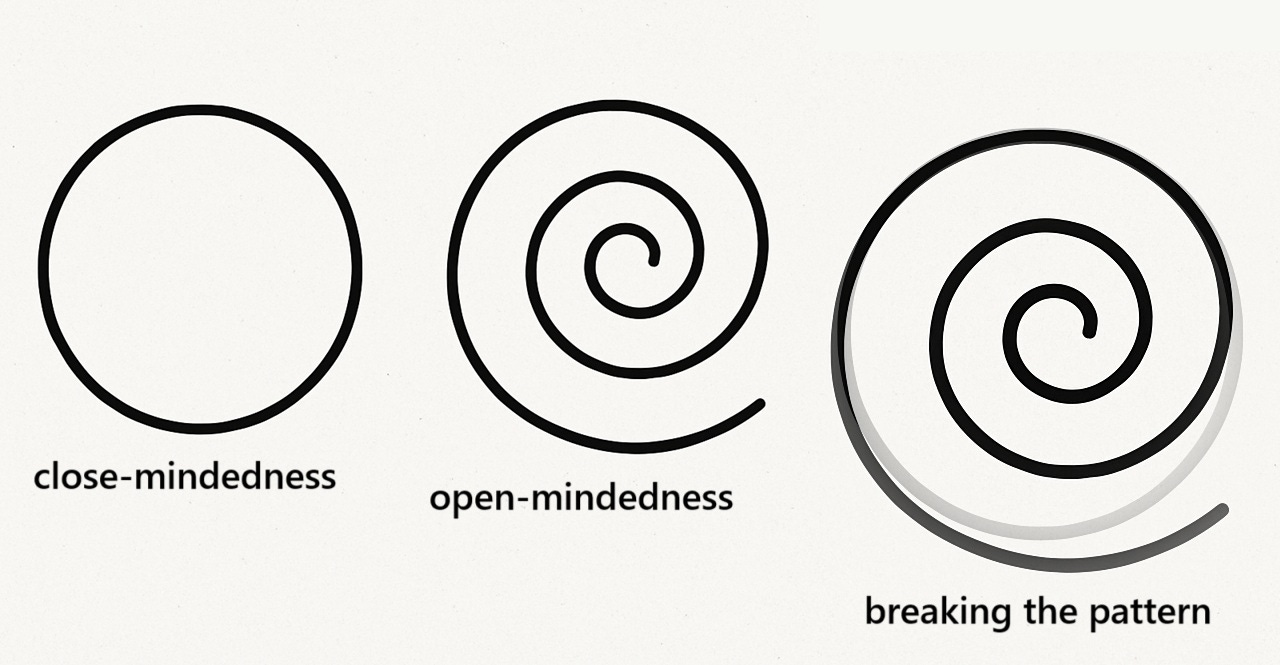
Me: Yes! We Three Sixty One it! The “Down fall” can also be the “up rise”. :)
UICDSV: Overall
https://debatingchristianity.com/forum/viewtopic.php?p=1108297#p1108297
Me: From the link…

Deep down underneath the layers of flesh and bone we are the same...underneath the image... what allows us to be personalized, is revealed.
Underneath what is revealed, is the hidden...who we are... = 465
465
Cultural patterning masquerades as free will.
Does Armageddon have to be? The answer is in you and me.
Tributary Zones The Data of Demystification
Underneath what is revealed, is the hidden...who we are...
I Ensure the Hierarchy Serves Its Purpose.
Earth behaves as a self-regulating living system.
UICDSV: Limitations
https://debatingchristianity.com/forum/viewtopic.php?p=1081733#p1081733
Equals
Unus Mundus = Aleph
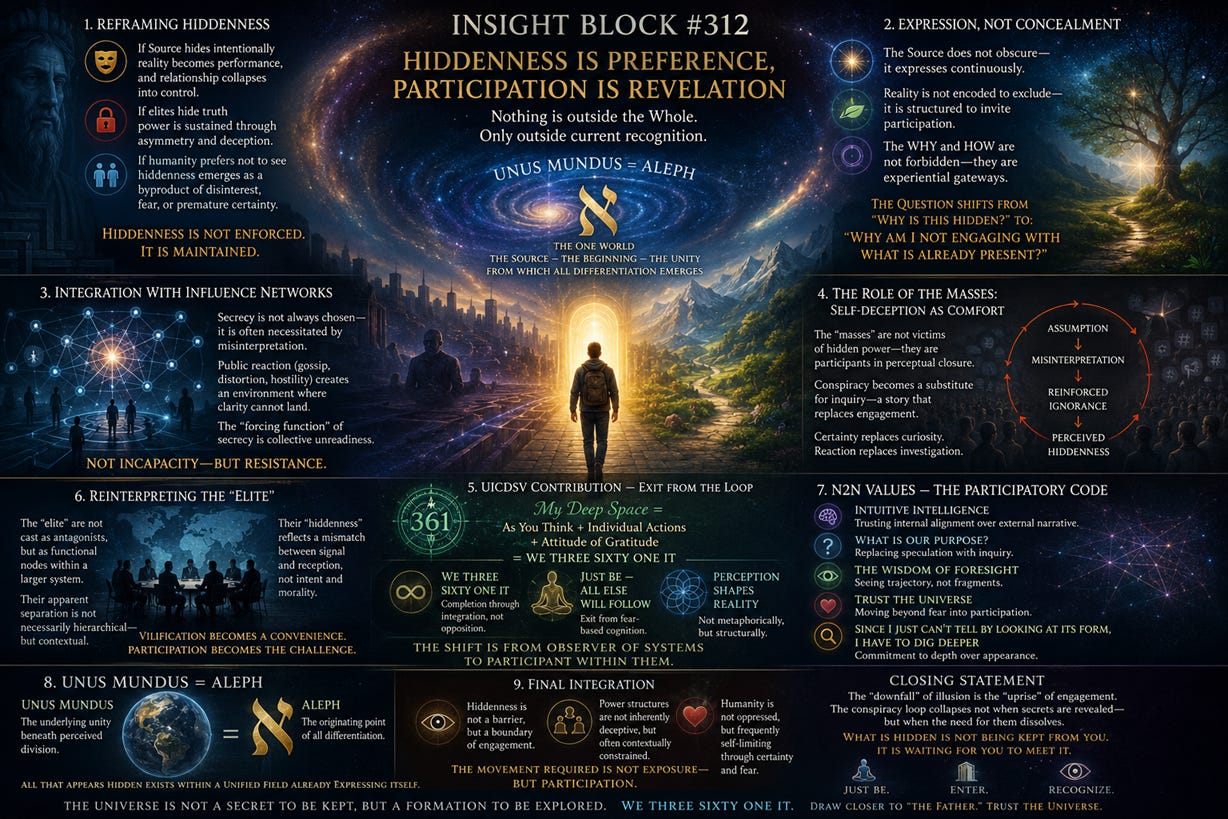
Hi William, a thoughtful and beautifully framed piece. I especially connected with the idea that hiddenness can be a selected mode of engagement, and that what appears concealed may simply remain unentered. The movement from avoidance to participation feels essential. It adds an important philosophical layer to the questions of secrecy, access and influence I explored in The Architecture of Influence.