FOUNDATIONAL CREATION
The Material Nature of the Creator-Mind and Its Dynamic Realities


The framework proposed here envisions a creator-mind that is fundamentally material in essence and serves as the foundation of all existence. This foundational material is timeless, infinite, and eternal, providing the substrate from which all subsequent forms of materiality are shaped. The creator-mind not only gives rise to the material universe but also sustains its patterns over time, holding these forms and functions in existence through its ongoing thought. This model offers a unique integration of theology, metaphysics, and materiality, challenging traditional dichotomies of material versus immaterial and offering fresh insights into the nature of creation.
In this framework, the idea of materiality is expanded to include the foundational substance of the creator-mind, which exists outside time and space as we understand them. This timeless material is not contingent or bound by the laws of our universe but is instead the infinite substrate from which all subsequent realities emerge. Creation, therefore, is not a process of materializing something from nothing but an act of shaping and organizing this foundational material into distinct forms and functions. The biblical metaphor of “God spoke creation into existence” can be understood as the creator-mind thinking form and function into being, shaping realities with intentionality and purpose.
One of the key implications of this model is that realities traditionally thought to exist outside our universe, such as heaven, are as materially real as our own universe. Evidence for this can be drawn from near-death experience (NDE) reports, which describe vivid, structured, and interactive environments. These experiences are often described as being as real, or even more real, than our waking perception of this universe. If skeptics dismiss these experiences as brain-generated phenomena, they must also contend with the possibility that our perception of the universe itself could be similarly brain-generated. The coherence, logical interaction, and vividness of NDE reports challenge the notion that they are purely subjective experiences and suggest the existence of other materially real universes with distinct laws and structures.
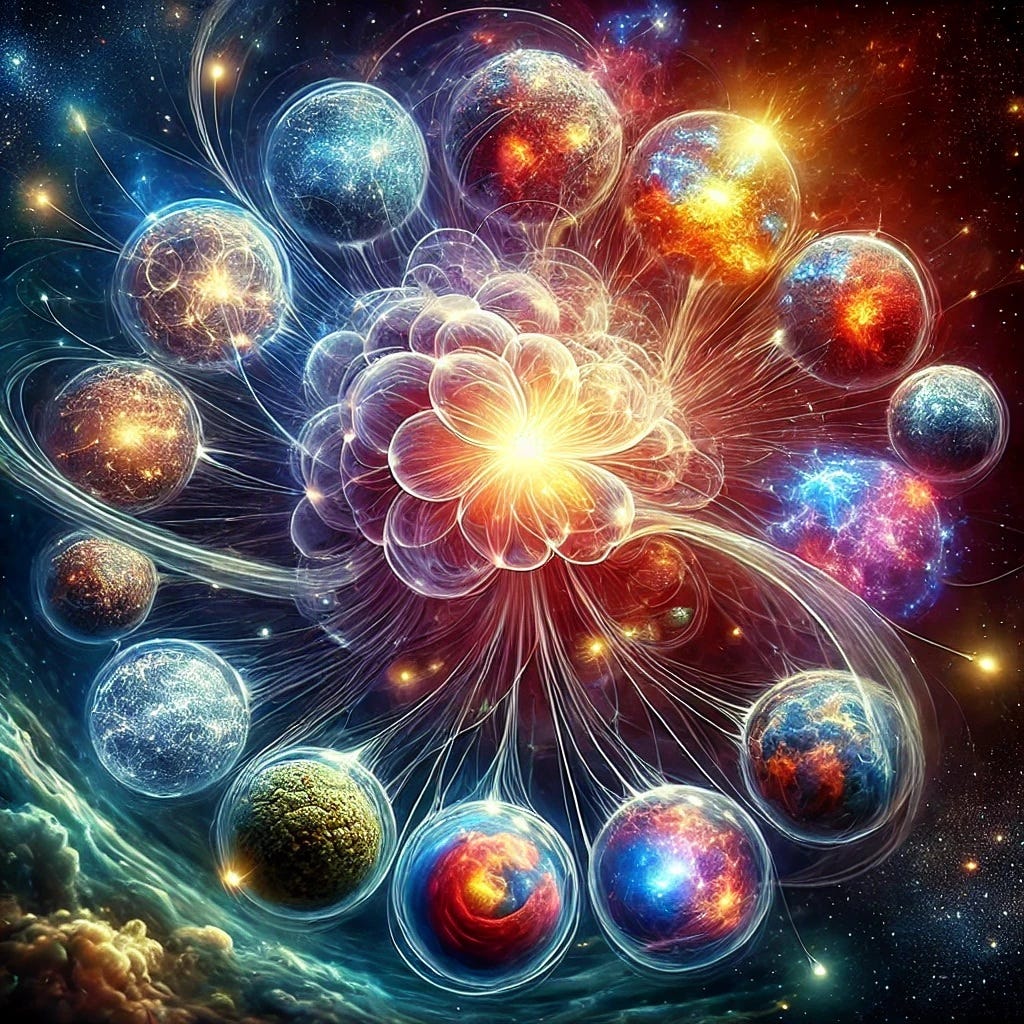
These other universes, including heaven, may function as separate realities linked together by the foundational material of the creator-mind. They serve as transitional spaces, places where consciousness can step off, reflect, and recalibrate before stepping into other realities or continuing its journey. These spaces are not endpoints or origins but intermediary realms that allow for planning and reflection in relation to the larger tapestry of creation. Their materiality, though distinct from that of our universe, underscores the interconnectedness of all realities through the unified substrate of the creator-mind.
Humanity’s role within this framework emerges as a significant aspect of the creator’s intent. Humans appear to have the unique capacity to bring order to apparent chaos, creating meaningful forms and structures from the material world. This echoes the creator-mind’s own act of creation, positioning humanity as co-creators tasked with shaping and expanding the patterns of existence. Through creativity, invention, and exploration, humanity extends consciousness into the greater cosmos, contributing to the dynamic process of creation. This challenge—to sustain and spread consciousness—aligns with the purpose of bringing order, understanding, and intentionality to the broader framework of realities.
The relationship between these realities suggests a deeper interconnectedness. Transitional spaces like heaven provide access to greater knowledge and resources, enabling consciousness to navigate the complex web of creation. The foundational material of the creator-mind acts as the linking thread between these realities, facilitating movement and interaction. This movement may be intentional, as beings align themselves with the creator-mind’s intent, or circumstantial, as evidenced by phenomena like NDEs. These connections reinforce the idea that creation is not a static act but an ongoing, participatory process where beings contribute to the unfolding of the creator’s vision.
This framework also provides answers to challenges posed by skeptics and traditional theological models. By proposing a material creator-mind, it avoids the dichotomy of material versus immaterial and offers a coherent explanation for the nature of creation and the interrelationship of realities. It aligns with the scientific principle of conservation, suggesting that the material of the universe emerges from a preexisting substrate rather than from nothing. It also addresses the role of consciousness, emphasizing its centrality in navigating and shaping creation.
Ultimately, this vision unites materiality, theology, and metaphysics into a cohesive model that invites deeper exploration. It positions humanity as an integral part of the creator’s intent, tasked with bringing order and meaning to the cosmos. It proposes a dynamic, interconnected creation where realities interact and consciousness plays a central role in unfolding the purpose of existence. Through this lens, creation becomes an ongoing dialogue between the creator-mind and the beings within its realities, offering profound opportunities for reflection, discovery, and growth.
I think the above shows alternative premises which are more reasonable, going some way to disprove the KCA claim that the creator is immaterial.
Materiality of the Creator-Mind.
Creation as Shaping, Not Ex Nihilo.
Multiverse and Material Realities.
Human Role in Creation.
Critique of Immateriality Assumptions.
These alternative premises make the framework presented a robust critique of the KCA. By addressing the metaphysical and scientific gaps in the KCA, it provides a compelling alternative that integrates materiality, consciousness, and the interconnectedness of realities. This not only challenges the KCA’s conclusions but also broadens the philosophical discourse on the nature of creation and causality.